
Stuck Transactions and the Cost of Waiting for a Confirmation
A Bitcoin transfer that sits unconfirmed is not lost, but it is unavailable, and unavailable money has a price. The Transaction Accelerator exists to shorten that wait: it prioritises a stuck transfer into the next block the pool mines. Meanwhile the mining side of the same account keeps producing — at 241 TH/s, 0.00010811 BTC a day, or $9.16 at $84,692 per BTC. This article looks at both halves of that ledger.

Key takeaways
- Free acceleration needs a transaction of 0.5 KB or less with a fee rate of at least 0.0001 BTC/KB, submitter first in the hourly queue.
- A 241 TH/s rig earns 0.00010811 BTC a day, $9.16 gross and $8.79 net of the listed 4% on the block-reward component.
- Accelerated transactions are included in the next block the pool mines and cannot be cancelled or refunded afterwards.
- Transactions with unconfirmed inputs must wait for the parent transfer to confirm before they can be pushed.
Why a transfer stalls in the first place
Block space is sold by weight, and miners pick the transfers that pay most per unit of it. When demand rises, the fee rate needed to reach the next few blocks rises with it, and anything submitted below that clearing level waits. The transfer is valid, signed and broadcast; it simply is not economic to include yet. Wallets that estimate fees from a quiet weekend can produce exactly this outcome on a busy Monday.
The wait has a cost that is easy to underestimate. Coins in flight cannot be sold, pledged or used to pay a bill, and the sender cannot cancel a signed transfer either. Rebroadcasting does not help, and sending a replacement with the same inputs risks a double-spend. What actually resolves the situation is either time or a mechanism that raises the priority of the existing transfer, which is what an accelerator does.
The free tier, stated precisely
The ViaBTC TX Accelerator takes a transaction hash and pushes that transaction into the queue for the next block the pool mines. The free submission route applies when the transaction is 0.5 KB or smaller and its fee rate is at least 0.0001 BTC/KB. Free capacity refreshes hourly and is handled first-in, first-served, so a submission at ten past the hour faces a shorter queue than one at fifty past.
Larger or cheaper transactions can use the paid route, settled in BTC, BCH or LTC and deducted from the account balance. Two conditions matter before paying anything: the transaction must not be a double-spend, and every input must already be confirmed. If the transfer spends an output from another unconfirmed transfer, accelerate the parent first and come back. Both rules exist because a block cannot contain a child whose parent is still pending.
What happens after submission
Once accepted, the request is final. The transaction is included in the next block the pool mines, and the submission cannot be cancelled, amended or refunded, including in the case where the transfer confirms through ordinary block space before the pool's next block arrives. That last scenario is not a failure of the tool; it is the network doing the same job faster, and the paid amount is still spent.
So the honest way to value acceleration is as an option on time, not a purchase of certainty. If the money is needed within the hour, the paid route has a clear purpose. If the transfer can wait a day, the same fee is better left in the account, because block space usually clears and the queue usually shortens. Nothing about the tool changes the amount being sent, and it does not raise the fee attached to the transaction itself.
Reading the mining side of the same account
Miners meet this problem from both directions: they send payouts, and they receive them. On the receiving side the arithmetic is fixed by network hashrate and the listed rate, and it does not pause while a withdrawal is pending.
| Hashrate | BTC per day | Gross USD per day | Net USD per day |
|---|---|---|---|
| 241 TH/s | 0.00010811 | $9.16 | $8.79 |
| 964 TH/s | 0.00043245 | $36.63 | $35.16 |
| 2.41 PH/s | 0.00108114 | $91.56 | $87.90 |
Daily income at 2.41 PH/s is 0.00108114 BTC, which is ten times the 241 TH/s figure to the digit. That predictability is the reason a delayed withdrawal is annoying rather than dangerous for a mining operation: the next hourly settlement arrives regardless, and the stuck transfer is a liquidity problem, not an income problem.
Worked example
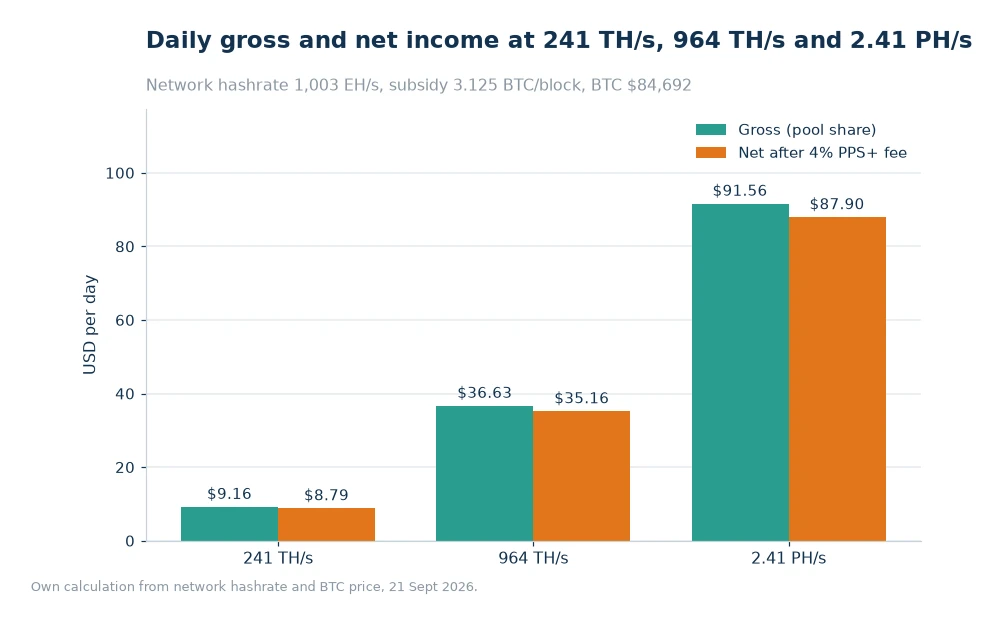
Run 241 TH/s through the pool formula, then scale it to the two larger bands in the chart.
- Daily output per terahash is 450 BTC ÷ 1,003,000,000 TH/s = 0.00000044865 BTC.
- 241 × 0.00000044865 = 0.00010811 BTC per day at 241 TH/s.
- At $84,692 per BTC: 0.00010811 × 84,692 = $9.16 gross.
- The listed 4% on the block-reward component is $0.37, leaving $8.79 net.
- At 964 TH/s, four times the hashrate: 0.00043245 BTC, $36.63 gross, and $35.16 after $1.47.
- At 2.41 PH/s, ten times: 0.00108114 BTC, $91.56 gross, and $87.90 after $3.66.
- At the 2.41 PH/s size, one day of net income covers a paid acceleration several times over — which is the comparison that decides whether to pay at all.
Keeping transfers out of the queue
Prevention is cheaper than acceleration. Withdraw in larger, less frequent batches rather than dozens of small transfers, since a transaction's weight grows with its inputs and a batched payout spreads one base cost across many recipients. Check the fee rate against current block conditions before signing, and leave a margin for the hours between signing and broadcast. An account that settles hourly makes it tempting to withdraw hourly too, which is exactly how a miner ends up with a stack of small, low-priority transfers competing for the same block space.
Timing helps as well. Fee pressure follows activity, and activity clusters. Where a transfer is not urgent, submitting it during a quiet window costs less than accelerating it later. When a transfer is genuinely urgent, the free tier is worth one attempt if it fits the 0.5 KB and 0.0001 BTC/KB thresholds, and the paid route is the fallback. Watching Pool Hashrate and the wider network through the statistics pages also tells you whether the chain is busy or idle before you commit.
Frequently asked questions
What does a free acceleration actually cost?
Nothing, provided the transaction is 0.5 KB or smaller and pays at least 0.0001 BTC/KB; the free quota refreshes hourly and requests are processed in the order they arrive.
Can I cancel an acceleration after submitting it?
No. Submission is final, there are no refunds, and the transaction goes into the next block the pool mines, so submit only when the transfer genuinely needs to move now.
Why was my request refused for unconfirmed inputs?
Because the transaction spends an output that has not confirmed yet, and a block cannot include a child before its parent; accelerate the earlier transfer first, then submit this one.
Decide with the clock, not the fear
Ask one question before submitting: how much does a delay of six hours cost? If the answer is larger than the paid fee, accelerate and move on. If the answer is smaller, wait, because block space clears on its own more often than a nervous sender expects. Keep the daily output figure beside that decision — at 964 TH/s it is $35.16 net, and at 2.41 PH/s it is $87.90 — so the fee is measured against income rather than against anxiety.
Sources: the ViaBTC accelerator page for the free-tier thresholds, queue rules and payment options[1], and the fee schedule for the listed 4%. Chain figures read 21 Sept 2026: network hashrate 1,003 EH/s, difficulty 132.76 T, subsidy 3.125 BTC per block, 144 blocks a day, BTC $84,692; published 22 Oct 2026.