
Writing a Men's Fragrance Brief That Can Be Costed: A Line-by-Line Map
A fragrance brief is a cost document before it is a creative one. Every line in it — concentration, format, pack, decoration, volume, number of variants — drives a cost line in the quotation, and a brief that leaves those lines open produces a quote that cannot be compared with anything. The practical rule is simple: write the brief so that each sentence can be assigned to a price. Brands that do this get quotations that differ in ways they can explain; brands that do not get quotations that differ in ways they cannot.
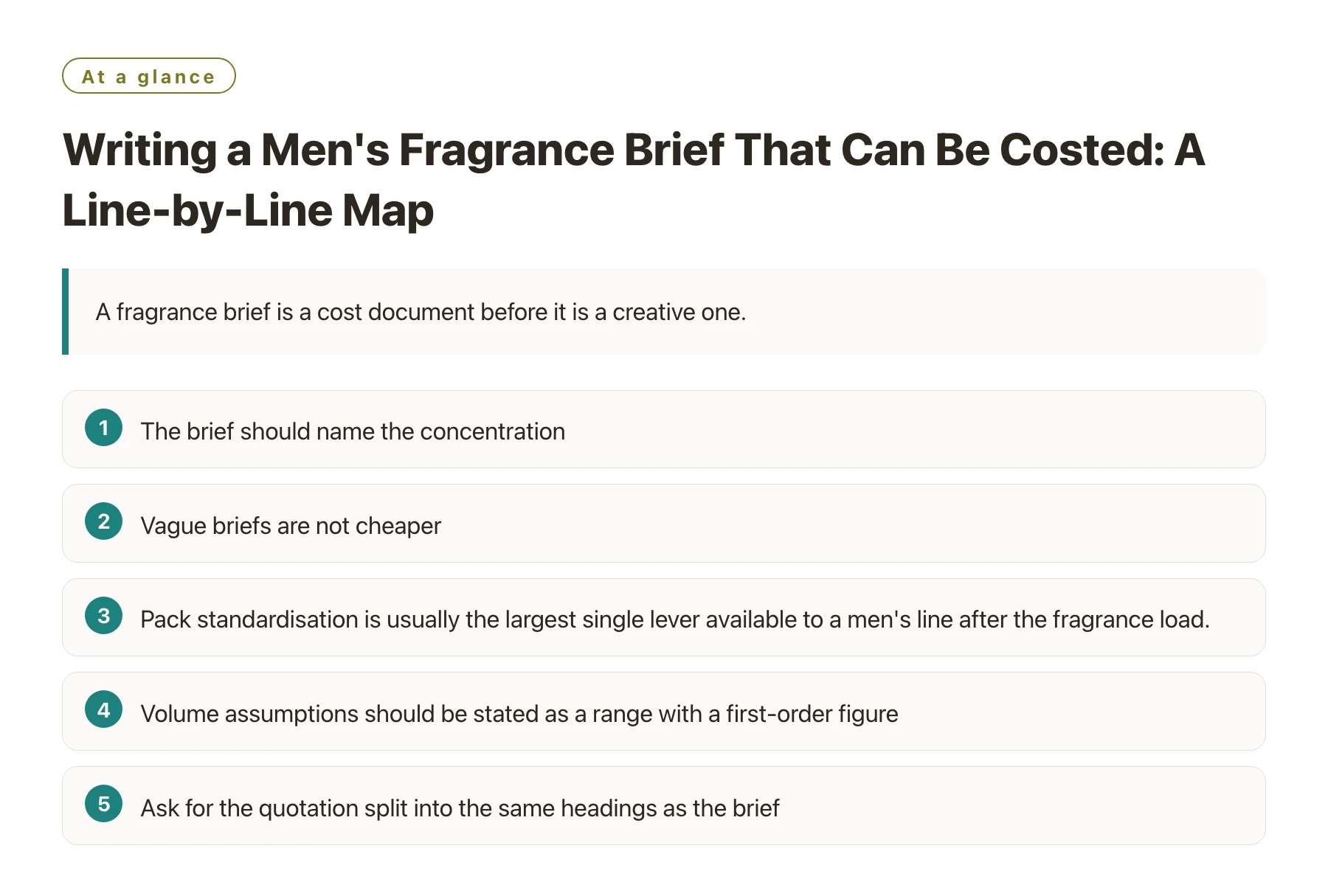
Key takeawaysThe brief should name the concentration, the fill size, the pack standard, the decoration method, the order volume and the number of scent variants, because these six lines carry most of the unit cost. · Vague briefs are not cheaper; they simply move the cost discovery to a later stage, when it is harder to change anything. · Pack standardisation is usually the largest single lever available to a men's line after the fragrance load. · Volume assumptions should be stated as a range with a first-order figure, so the factory can price both the tooling and the run. · Ask for the quotation split into the same headings as the brief, so two suppliers can be compared line by line rather than in total.
Most briefs are written for a perfumer and then forwarded to a commercial team, which is why they cause so much friction. A perfumer needs a description of the intended experience. A costing team needs quantities, standards and methods. The same document can serve both, but only if the commercial lines are explicit rather than implied.
This article maps the brief's commercial lines to the costs they generate, in the order a quotation is normally built. It is written for a brand buying a men's line, where pack formats are often heavy and decoration is often the difference between a premium and a mass impression.
Why a vague brief produces an expensive quote
When a brand writes that it wants a premium feel, a strong projection and a launch within a season, the manufacturer has to price a range of possibilities and protect itself against the worst one. That protection appears in the quote as a higher unit price, longer lead time or a wider tolerance. Vagueness is not free; it is priced as risk.
A brief that fixes the pack standard, the decoration method and the volume removes most of that uncertainty, and the quotation becomes a description of work rather than a hedge.
The brief's six commercial lines
Concentration and fill size, pack standard, decoration method, closure type, order volume and number of variants. If a brief answers those six, the remaining questions are technical and belong to the manufacturer. If it does not, the manufacturer will ask them anyway, and the calendar will absorb the delay. It also helps to read how a manufacturer describes its own scope before sending the brief out, because a supplier whose account of Xuelei China matches the structure of your brief will usually return a quotation in the same structure.
Compliance lines belong in the brief too
Two regulatory items interact with cost and should be stated rather than discovered. Fragrance materials are restricted per material and per product category, so the concentration and product type in the brief determine how much room the formula has [1]. And packaging is increasingly regulated as well as designed: the EU's work on packaging and packaging waste means pack choices carry a compliance dimension alongside the price, and refill or lighter-weight formats can be a commercial decision rather than only a marketing one [2].
The cost map: brief line to quotation line
| Brief line | What it drives in the quote | How it behaves at volume | How to write it |
|---|---|---|---|
| Concentration and fragrance load | The share of the most expensive input in the bottle | Almost linear with load; a small shift changes unit cost noticeably | State the target wear profile and let the manufacturer propose the load that achieves it |
| Fill size | Juice volume, bottle size, carton size and freight weight | Changes by steps when the bottle size changes | Give one fill size for the launch and note the intended future size |
| Pack standard or custom | Tooling, minimum order for the component and decoration setup | Standard packs fall in price quickly; custom packs stay expensive at low volume | Say whether a stock bottle is acceptable for the first run |
| Decoration method | Setup cost, per-unit cost and rejection rate | Screen printing becomes economical earlier than hot stamping or coating | Name one primary method and one fallback, with a target unit cost for each |
| Closure type | Crimp or screw, pump or cap, and the leak-testing regime | Component minimums often decide the real entry volume | Specify the closure and whether refill or travel formats are planned |
| Order volume and variants | Setup amortisation, component minimums and line changeover time | The single largest driver of headline unit price at low volume | Give a first-order quantity and a twelve-month range, separately |
The last row deserves emphasis: a first order of a few thousand units against a twelve-month plan of twenty thousand is a different commercial proposal from a one-off small run, and most factories price it differently. Stating both numbers in the brief is what lets them do so.
Three decisions that move the men's line price most
After the six lines above, three decisions account for most of the variation between one quote and another for the same brief.
How standard the pack is
A men's line often wants weight and a certain seriousness in the hand, which pushes toward heavy glass, a metal cap and a coating. Each of those is a separate setup and a separate unit cost. The way to keep the feel and the budget is to choose a standard heavy bottle and spend the custom money on one decoration step rather than on a bespoke mould.
How many variants the launch carries
Two scents in the same pack share tooling and component orders and roughly halve the per-variant setup. Two scents in two different packs do not. This is worth deciding before the brief is finalised rather than after the first quote, because it is the cheapest structural saving available to a new line.
How the manufacturer is asked to quote
Ask for the quotation under the same headings as the brief, with setup and unit costs separated, and with the volume assumption printed on it. Then compare two suppliers line by line; the totals will rarely be the interesting part. A partner that runs development and filling under one roof will usually produce that breakdown without being pushed, because fragrance manufacturing under one roof means the internal cost lines are already visible to it.
Keep the brief to two pages and attach a cost sheet as the third page: brief line on the left, the factory's number on the right, blank where the answer is still open. Blank cells are the point of the exercise — they show what is still unknown before work starts. If a comparison later feels confusing, the most common reason is that a supplier fills in costs the brief never mentioned, which is exactly what reading a perfume price breakdown is for.
Sources
- IFRA Standards Library (International Fragrance Association) —— The IFRA Standards Library lists the restrictions the fragrance industry applies to individual fragrance ingredients, based on safety assessments; it is the reference point for compliant fragrance formulation.
- European Commission: Packaging Waste and the PPWR —— EU rules on packaging and packaging waste, including the Packaging and Packaging Waste Regulation requirements on recyclability and design.
Frequently asked questions
How long should a fragrance brief be?
Two pages of decisions plus a one-page cost sheet is enough for most projects. Length is not the constraint; unresolved lines are. A three-page brief that leaves the volume and the pack standard open is weaker than a one-page brief that settles them.
Should the brief include a target unit cost?
Yes. A target gives the manufacturer something to design toward and makes the trade-offs visible. Give a target and a ceiling rather than a single hard number, and say which of the two is negotiable.
Why do two factories quote very different prices for the same brief?
Usually because they read different volumes, different pack standards or different decoration methods into it, or because one is including development work and the other is not. Asking both to quote under the same headings exposes which of those it is.
Does a heavier concentration always cost more?
It costs more in materials, because the fragrance compound is an expensive input, but the effect on the unit price depends on the rest of the pack. On a heavy glass bottle with coating, a modest change in load can be a small share of the total; on a light format it can be one of the largest variables.
What should I do if a quotation arrives with a single total price?
Send it back and ask for the headings from your brief, with setup and unit costs separated and the volume assumption stated. A supplier that cannot break the price down cannot help you negotiate the structure later, which is where most of the money actually is.