
Fee Rates on Merged Mining: LTC and DOGE Payouts
Litecoin produces a block every 2.5 minutes, which is 576 blocks a day and 3,600 LTC of network issuance at the current 6.25 LTC subsidy — about $218,448 a day with LTC at $60.68. Merged mining adds Dogecoin output on top of that reward instead of replacing any part of it, and the fee question only makes sense once the two streams are kept apart.

Key takeaways
- LTC scales per GH/s, not per TH/s: 0.00132626 LTC a day per GH/s, about $0.0805, so 10 GH/s earns roughly $0.80 a day and 1 TH/s earns about $80.48.
- PPS+ charges 4% on the block reward as PPS settles it and 2% on transaction fees; PPLNS charges 2% on both components taken together.
- Merged DOGE output rides along with the Scrypt work and should be valued as a separate line, not blended into the LTC figure.
- LTC's 2.5-minute blocks mean six confirmations arrive in about 15 minutes, so a PPLNS payout clears far sooner in wall-clock terms than the same rule on a ten-minute chain.
Two rewards from one unit of work
Merged mining is the reason LTC and DOGE appear together in a miner's dashboard. The same Scrypt hashing that satisfies Litecoin's difficulty also satisfies Dogecoin's, so a block found on the LTC chain carries the DOGE block reward in the same coinbase transaction. The LTC side is the part with published reference figures: difficulty of 94,799,394 implies a network hashrate of about 2.71 PH/s, and each GH/s of that network earns 0.00132626 LTC a day, which is about $0.0805.
Scale it and the shape is clear. Ten GH/s produces roughly $0.80 of LTC income a day. One TH/s, which is 1,000 GH/s, produces about $80.48 a day. A 100 TH/s Scrypt farm is a four-figure daily line. The DOGE side is deliberately absent from those numbers, because it arrives as a separate asset with its own quantity and its own price, and mixing it into the LTC total makes both streams harder to audit. Treat the merged output as its own row and value it at its own market price on the day you reconcile.
That separation matters for the fee too. The listed rates are published against specific components of the payout, so a projection that blends LTC and DOGE into one number has already broken the link between the rate and the base it was written for.
Where the listed fee lands on a merged payout
Read the schedule by component. Under PPS+ the pool charges 4% against the block reward as PPS settles it, plus 2% against the transaction-fee component, and it pays out hourly at current difficulty. Under PPLNS a single 2% charge applies to the block reward and the transaction fees together, and the payment lands after 6 confirmations, shared across the last 5 difficulty rounds in proportion to hashrate contributed inside that window.
The practical difference for a merged miner is what remains in the miner's own ledger. PPS+ moves pool luck and orphan-block outcomes off the miner's statement and charges the higher component rate for it. PPLNS leaves both with the miner and charges the lower rate. Neither is a free lunch; the four-percent line is the price of the haircut being someone else's problem.
Then ask the question the schedule does not answer for you: how does the merged DOGE output enter the payout mode you selected? Build the projection with that answer in writing rather than assuming a symmetric treatment, because a DOGE stream valued at its own price on a large farm can move the total by more than the fee difference you spent the afternoon comparing.
| Line | Value | What it means for payout |
|---|---|---|
| Block interval | 2.5 minutes, 576 blocks a day | Payouts and confirmations arrive faster than on a ten-minute chain |
| Block subsidy | 6.25 LTC | Network issuance is about 3,600 LTC a day |
| Network hashrate | About 2.71 PH/s at 94,799,394 difficulty | Your share of that figure sets the ceiling on income |
| Per GH/s per day | 0.00132626 LTC, about $0.0805 | The smallest useful unit for pricing a Scrypt rig |
| Per TH/s per day | About $80.48 gross | 1,000 GH/s is the natural fleet unit |
| Merged DOGE | Separate asset on top of the LTC reward | Value it on its own line, at its own price |
Worked example: 1 TH/s of Scrypt for 30 days
Run the lines in order for a single TH/s, with the LTC price at $60.68. Gross income is 0.00132626 LTC per GH/s per day multiplied by 1,000 GH/s, so 1.32626 LTC a day, which is $80.48. Over 30 days that is 39.7878 LTC, or $2,414.34 at the day's price. The four-percent charge on the block-reward component takes $3.22 a day, about $96.58 across the month, leaving $77.26 a day and $2,317.76 for the period. The two-percent combined rate would take $1.61 a day, about $48.29 a month, and leave $78.87 a day.
Now shrink it to a 10 GH/s home rig, which is where most merged-mining readers start. Gross income is 0.0132626 LTC a day, about $0.80. The four-percent charge is roughly $0.032 a day, or $0.97 a month, and the two-percent alternative is about $0.49. At that size the fee is not the variable that decides whether the rig runs — the power bill is. What the fee changes is the payout cadence and the variance, and both of those are visible in the first week on a chain that mints a block every 150 seconds.
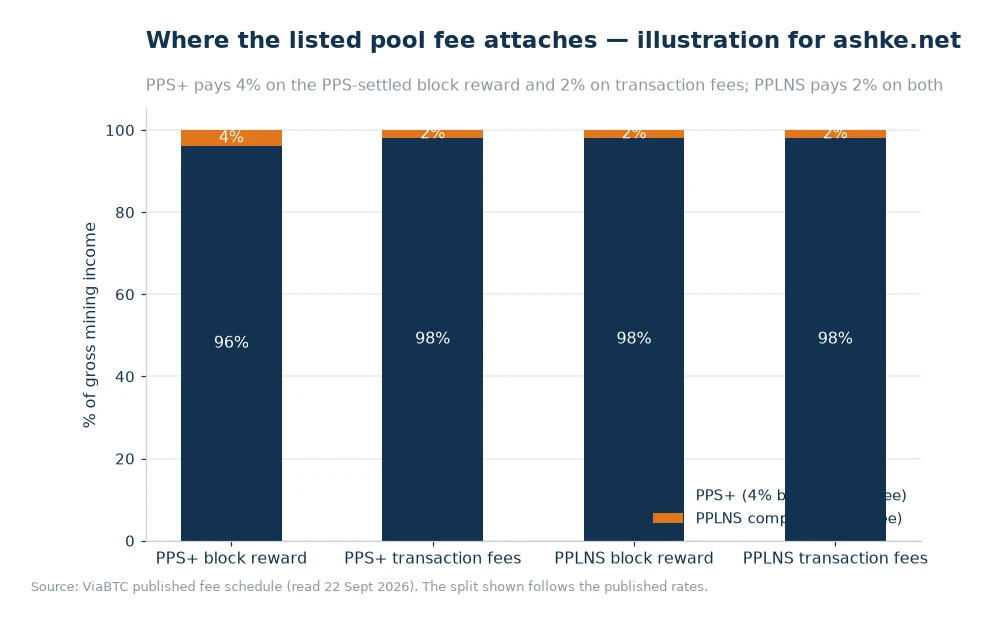
Notice what the chart does not contain: a row for the merged DOGE reward. That is the point of keeping it separate. If a DOGE payout lands in the same account, the payout history shows two credits rather than one, and the fee you can attribute to each should come from the schedule's own component definitions rather than from a blended figure you built in a spreadsheet.
Put the rate beside the component
A merged miner's estimate sheet needs four columns: LTC gross, the component the rate touches, the DOGE stream, and the net after everything. With 1 TH/s producing $80.48 a day of LTC income, the component matters more than a tenth of a percentage point, because $3.22 a day is the difference between an hourly payout and a payment that waits for confirmations. The environment that publishes these rates alongside the component breakdown is where to check the current numbers, including the ViaBTC Pool Fees table, and a Profit Calculator that accepts a merged-mining estimate is the quicker way to test a Scrypt fleet at today's LTC price than rebuilding the formula by hand. When the LTC and any merged DOGE balance land in the same place, the multi-currency wallet keeps the two streams in one account without forcing a conversion.
Frequently asked questions
Does merged mining change the LTC fee rate?
The listed rates attach to payout components, not to the chain that produced them: 4% on the PPS-settled block reward and 2% on transaction fees under PPS+, or 2% across both components under PPLNS. Merged output is a separate asset, so value it on its own line before adding it to any total.
How long does an LTC payout take under PPLNS?
Payment follows 6 confirmations over the last 5 difficulty rounds. With 2.5-minute blocks, six confirmations take about 15 minutes, and the round window refills roughly four times faster than it would on a chain minting 144 blocks a day.
Is 10 GH/s enough hashrate to bother with merged mining?
It earns about $0.80 of LTC income a day, so the fee is worth roughly $0.032 a day under the four-percent rate. The DOGE output and the shorter payout cadence are the reasons small Scrypt rigs join: the second stream adds value that the LTC line alone does not show.
Keep the two ledgers apart
Write the LTC line, apply the rate to the component it belongs to, then add the merged output as its own row at its own price. Re-run the sheet when LTC difficulty moves, because 94,799,394 is the number that decides how many LTC a GH/s earns and it changes every few days. A merged miner who tracks both streams separately will see the fee as a small, predictable line and the variance as a property of the payout mode — which is exactly the information needed to choose between them.
Data and sources: ViaBTC listed fee schedule[1] and payout rules as published. LTC difficulty (94,799,394), the implied network hashrate of 2.71 PH/s, the 6.25 LTC subsidy, the 2.5-minute block interval and the LTC price of $60.68 were read 22 Sept 2026. Merged DOGE output is priced separately and is not included in these LTC figures. All values are arithmetic on those inputs, change with difficulty and price, and are not a promise of earnings.